Skip to content
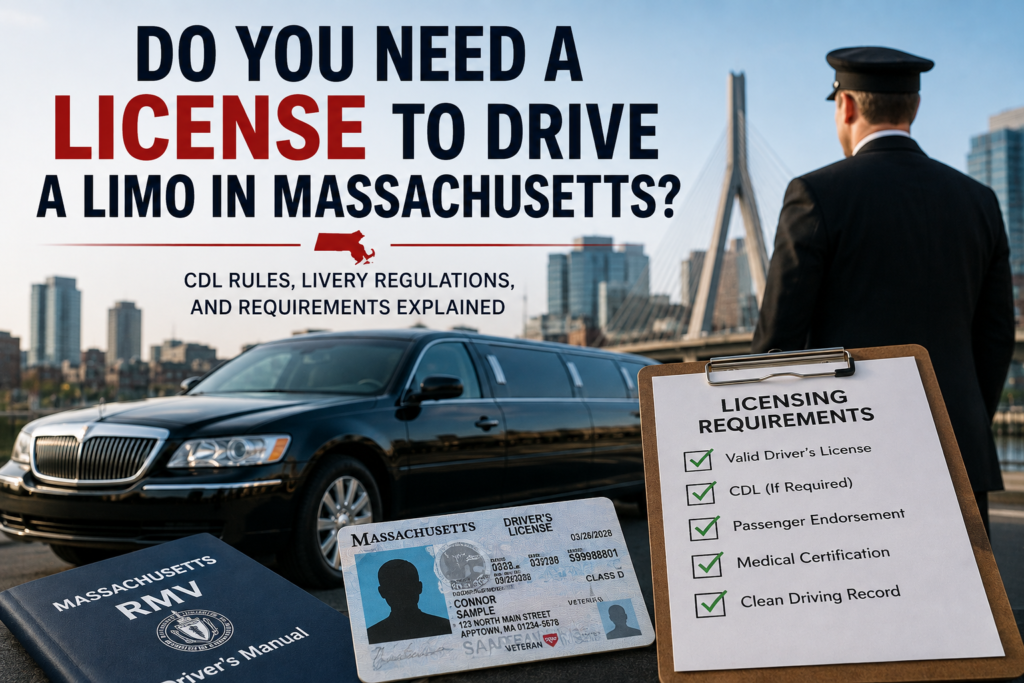
If you’re wondering, “Do you need a license to drive a limo in Massachusetts?”, the answer depends on the type of limousine and how many passengers the vehicle is designed to carry. A limousine driver needs a valid Massachusetts driver’s license appropriate for the vehicle being operated, but not every limousine driver automatically needs a Commercial Driver’s License (CDL).
Massachusetts uses different license classes based on the type, size, and passenger capacity of a vehicle. A standard Class D driver’s license allows a driver to operate typical passenger vehicles, vans, and small trucks. Larger passenger vehicles may require a CDL, including the appropriate passenger endorsement.
The distinction is particularly important for limousine operators because Massachusetts defines a livery vehicle as a limousine or other vehicle designed to carry 15 or fewer passengers, including the driver, when used for hire or other pre-arranged transportation.
This guide explains Massachusetts limo driver licensing requirements, CDL rules, livery regulations, passenger limits, and what prospective limousine drivers should know before operating a vehicle commercially.
Do You Need a Special License to Drive a Limo in Massachusetts?
There is not one universal “limousine driver’s license” that every limo driver in Massachusetts must obtain.
Instead, the required driver’s license depends largely on the vehicle being operated.
The Massachusetts Registry of Motor Vehicles issues several driver’s license classes. The most common is a Class D passenger license, which permits the holder to operate regular passenger vehicles, vans, and small trucks.
If the limousine or passenger vehicle falls into a category requiring a commercial license, the driver may need a Class A, B, or C CDL, depending on the vehicle’s characteristics.
This means the question is not simply whether the vehicle is called a “limo.” The more important questions are:
- How many passengers is the vehicle designed to carry?
- What is the vehicle’s weight rating?
- Is the vehicle classified as a commercial motor vehicle?
- Does it require a passenger endorsement?
- What type of transportation service is being provided?
Understanding these distinctions is essential for anyone researching a Massachusetts limo driver license.
What License Is Required to Drive a Limousine in Massachusetts?
For a limousine that falls within the requirements of a standard passenger vehicle, the applicable Massachusetts driver’s license may be a Class D license.
Massachusetts describes the Class D license as the standard passenger license used for regular passenger vehicles, vans, and small trucks.
However, the licensing requirements change when the vehicle meets the definition requiring a commercial driver’s license.
Massachusetts states that a CDL is required to operate, among other vehicles:
- A single vehicle with a gross vehicle weight rating of 26,001 pounds or more
- Certain combination vehicles meeting the applicable weight thresholds
- A vehicle designed to transport 16 or more passengers, including the driver
- Certain vehicles transporting hazardous materials requiring placards
Therefore, a person researching how to get a license to drive a limousine in Massachusetts should first determine the exact vehicle they intend to operate.
When Does a Massachusetts Limo Driver Need a CDL?
One of the most important questions is: Do limo drivers need a CDL in Massachusetts?
Not automatically.
A CDL is required when the vehicle falls into one of the categories established by Massachusetts and applicable federal commercial-driver rules.
One particularly important threshold is passenger capacity.
Massachusetts requires a CDL for a vehicle designed to transport 16 or more passengers, including the driver.
For a commercial vehicle requiring a passenger endorsement, the driver must have the appropriate CDL and Passenger (P) endorsement. Massachusetts explains that the P endorsement allows a CDL holder to carry passengers and requires the applicable testing.
This is why passenger capacity matters so much when determining the license requirements for a limousine.
A vehicle that falls below the CDL passenger threshold may not require the same commercial license solely because it is used as a limousine.
What Is a Livery Vehicle in Massachusetts?
The term livery vehicle is especially important when discussing Massachusetts limousine regulations.
Massachusetts defines a livery vehicle as a limousine or other vehicle designed to carry 15 or fewer passengers, including the driver, that carries passengers for hire, business courtesy, employee shuttle, customer shuttle, charter, or other pre-arranged transportation and is not required to obtain a taxicab license.
The Massachusetts Department of Transportation also explains that a livery vehicle can carry up to 15 people, including the driver, and is used for pre-arranged trips rather than being hailed from the street like a taxi.
This distinction helps explain why a limousine and a large passenger bus may have very different licensing requirements even though both provide paid transportation.
Massachusetts Limo Driver Requirements
The specific requirements for becoming a limousine driver can depend on the vehicle and the type of transportation service.
At a minimum, a prospective driver should make sure they have the appropriate Massachusetts driver’s license for the vehicle they will operate.
Depending on the vehicle, additional requirements may apply.
These can include:
- Holding the appropriate driver’s license class
- Meeting applicable age requirements
- Maintaining a valid driving record
- Obtaining a CDL when required
- Obtaining a Passenger (P) endorsement when required
- Meeting applicable medical certification requirements
- Completing required testing and training for a CDL
- Meeting employer requirements
- Following applicable municipal livery regulations
Drivers should also understand that a limousine company’s requirements may be stricter than the minimum licensing requirements.
For example, a professional transportation company may require additional experience, background screening, driving-history checks, safety training, or other qualifications before allowing a driver to transport clients.
Does a Stretch Limousine Require a Different License?
Not necessarily.
The fact that a vehicle is called a stretch limousine does not by itself determine the driver’s license class.
What matters is the vehicle’s applicable classification, passenger capacity, weight, and other characteristics.
For example, if a stretch limousine is designed to carry 15 or fewer passengers including the driver and otherwise falls within the applicable livery framework, the vehicle is treated differently from a commercial passenger vehicle designed for 16 or more people.
Massachusetts’ definition of a livery vehicle specifically includes limousines designed to carry 15 or fewer passengers including the driver.
Therefore, someone operating a stretch limousine should not assume that the vehicle’s appearance alone determines whether a CDL is required.
The vehicle’s actual specifications are what matter.
What Is the Difference Between a Class D License and a CDL?
The easiest way to understand the difference is to look at the type of vehicle each license is designed to cover.
A Class D license is Massachusetts’ standard passenger license. It allows the holder to operate regular passenger vehicles, vans, and small trucks.
A CDL is required for certain larger or specialized commercial vehicles.
Massachusetts divides CDLs into Classes A, B, and C.
A Class C CDL, for example, applies to certain vehicles that don’t meet the definitions of Class A or B but are designed to transport 16 or more passengers, including the driver, or that meet certain hazardous-material requirements.
The appropriate CDL endorsement may also be required.
For passenger transportation, the P endorsement is particularly important. Massachusetts states that this endorsement permits a CDL holder to carry passengers.
What Is a Passenger Endorsement?
The Passenger, or P, endorsement is an endorsement added to a CDL for drivers who are qualified to transport passengers in applicable commercial vehicles.
Massachusetts lists the P endorsement as a Passenger endorsement and requires written and road testing for it.
The state’s CDL manual explains that drivers who wish to operate a vehicle with a design capacity of 16 or more people, including the driver, must add the Passenger endorsement to their CDL or Commercial Learner’s Permit.
This is an important distinction for anyone searching for Massachusetts limo driver requirements because the number of seats can affect the type of license and endorsement required.
Massachusetts Livery Vehicle Regulations
Driver licensing is only one part of operating a limousine business.
The vehicle and business must also comply with applicable livery requirements.
Massachusetts describes livery vehicles as vehicles designed for 15 or fewer passengers including the driver that provide pre-arranged transportation. The state also provides a specific livery registration plate category for qualifying vehicles.
The Massachusetts RMV explains that livery services are regulated largely at the municipal level. Apart from areas such as motor vehicle registration and minimum motor vehicle liability insurance standards, livery companies are generally subject to local regulation rather than being overseen by one single statewide livery regulatory agency.
That means limousine operators should check the requirements of the particular Massachusetts city or town where they operate.
Local rules can affect licensing, permits, operating requirements, and other aspects of a livery business.
How to Become a Professional Limo Driver in Massachusetts
If you’re considering becoming a professional limousine driver, start by identifying the type of vehicle you will drive.
For a standard passenger vehicle, determine whether a Massachusetts Class D license is appropriate.
If the vehicle requires a CDL, determine the correct CDL class and whether a Passenger endorsement is required.
Massachusetts allows applicants to apply for an intrastate CDL beginning at age 18. Drivers operating commercially across state lines are subject to additional federal age requirements; Massachusetts notes that CDL holders must generally be at least 21 to operate a commercial motor vehicle in interstate commerce.
For CDL applicants, the process can involve:
- Determining the correct CDL class
- Applying for a Commercial Learner’s Permit
- Passing the applicable knowledge tests
- Obtaining required endorsements
- Completing required training where applicable
- Passing the required road test
- Meeting applicable medical certification requirements
- Obtaining the appropriate CDL
Massachusetts states that Passenger endorsements require applicable testing, and certain CDL applicants must complete entry-level driver training before taking the road test.
Do Limo Companies Have Additional Requirements?
Yes. A transportation company can establish hiring and operating requirements beyond the minimum state driver’s license requirements.
For example, a professional limousine company may evaluate:
- Driving experience
- Driving record
- Customer-service skills
- Professional appearance
- Knowledge of local roads
- Airport transportation experience
- Background-check requirements
- Vehicle safety procedures
- Ability to work early mornings, evenings, weekends, and holidays
This is one reason why having the appropriate license is only one part of becoming a professional chauffeur.
A chauffeur represents the transportation company throughout the customer’s trip, so reliability, professionalism, punctuality, and safe driving can be just as important to an employer as the basic licensing requirements.
What About Medical Requirements for Commercial Drivers?
Certain commercial drivers must meet federal and state medical certification requirements.
Massachusetts states that commercial drivers operating vehicles over 10,000 pounds generally must carry an approved medical certificate. It also states that drivers transporting 15 or more passengers or carrying certain placarded hazardous materials are subject to medical certification requirements, with specified exceptions.
Because medical requirements can depend on the type of vehicle and operation, drivers should verify their specific situation before beginning commercial passenger transportation.
This is particularly important for drivers moving into larger passenger vehicles that require a CDL.
What Happens If the Vehicle Carries 16 or More Passengers?
Passenger capacity is one of the most important factors in determining CDL requirements.
Massachusetts states that a CDL is required for a vehicle designed to transport 16 or more passengers, including the driver.
The applicable commercial license class and Passenger endorsement then become important.
For a passenger vehicle requiring the P endorsement, Massachusetts requires the appropriate class of vehicle for the road test, and the vehicle must be designed to carry 16 or more passengers including the driver.
Therefore, operators of large limousine buses, passenger coaches, or similar vehicles should pay particular attention to CDL requirements rather than assuming the rules for smaller livery vehicles apply.
Limo Driver Licensing vs. Livery Vehicle Registration
Another important distinction is that driver licensing and vehicle registration are not the same thing.
A driver needs the appropriate license to operate the vehicle.
The vehicle itself may need the appropriate registration and, when applicable, livery plates.
Massachusetts’ RMV materials state that qualifying livery vehicles can receive Livery Normal plates and describe eligibility based on the vehicle being designed for 15 or fewer passengers including the driver and being used for qualifying passenger transportation.
In other words, having a valid driver’s license does not by itself mean that a vehicle is properly registered for commercial livery use.
Both sides of the operation need to be considered.
Why Professional Licensing Matters for Boston Limo Service
Passengers booking a professional limousine service aren’t simply paying for a vehicle.
They are paying for a transportation experience that depends on qualified drivers, properly maintained vehicles, reliable scheduling, and compliance with applicable transportation requirements.
For airport transportation, this is particularly important.
A professional chauffeur may need to navigate Boston traffic, coordinate airport pickups, accommodate luggage, and adjust the schedule when flights change.
Whether you’re booking Boston limo service, corporate transportation, wedding transportation, or airport transportation, the professionalism of the driver is an important part of the overall experience.
For travelers heading to Logan Airport, reliable Boston Logan limo service can also remove the stress of driving, parking, and navigating airport traffic independently.
Frequently Asked Questions About Massachusetts Limo Licenses
Do you need a license to drive a limo in Massachusetts?
Yes. A limousine driver must hold a valid Massachusetts driver’s license appropriate for the vehicle being operated. However, not every limousine automatically requires a CDL. The applicable requirements depend on the vehicle’s classification, passenger capacity, weight, and other factors.
Do limo drivers need a CDL in Massachusetts?
Not necessarily. A CDL is required for vehicles that meet Massachusetts’ commercial-driver criteria, including vehicles designed to transport 16 or more passengers including the driver. Smaller qualifying livery vehicles may fall under different requirements.
What license do you need to drive a limousine in Massachusetts?
The required license depends on the limousine. A standard passenger vehicle may be operated with an appropriate Class D license, while vehicles meeting CDL requirements require the appropriate commercial license class and, when applicable, a Passenger endorsement.
Does a stretch limousine require a CDL?
Not automatically. Being a stretch limousine does not by itself determine whether a CDL is required. Passenger capacity, vehicle classification, weight, and other applicable requirements must be considered.
What is a livery vehicle in Massachusetts?
Massachusetts defines a livery vehicle as a limousine or other vehicle designed to carry 15 or fewer passengers, including the driver, that carries passengers for hire or provides qualifying pre-arranged transportation.
How many passengers can a Massachusetts livery vehicle carry?
A Massachusetts livery vehicle is defined as a vehicle designed to carry 15 or fewer passengers, including the driver.
What is a Passenger endorsement?
The Passenger, or P, endorsement is a CDL endorsement that permits a qualified CDL holder to carry passengers in applicable commercial vehicles. Massachusetts requires the applicable testing for the endorsement.
Are limousine services regulated by Massachusetts?
Livery services are regulated largely at the municipal level. Massachusetts provides statewide requirements involving areas such as vehicle registration and insurance, while local authorities may have additional rules governing livery operations.
What are the requirements to become a professional limo driver?
The requirements depend on the vehicle and operation. Drivers need the appropriate driver’s license and may need a CDL, Passenger endorsement, medical certification, training, testing, and other qualifications depending on the vehicle and service.
Can a Class D driver operate a limousine?
A Class D license allows operation of vehicles within the Class D category. Whether a particular limousine can be operated with a Class D license depends on the vehicle’s classification and applicable requirements. Massachusetts does not determine the license requirement simply from the word “limousine.”
Final Answer: Do You Need a License to Drive a Limo in Massachusetts?
So, do you need a license to drive a limo in Massachusetts?
Yes, but the exact license depends on the vehicle you are operating.
A smaller limousine that falls within the applicable livery vehicle definition may not require the same commercial license as a large passenger vehicle. Massachusetts defines qualifying livery vehicles as limousines or other vehicles designed to carry 15 or fewer passengers including the driver.
When a vehicle is designed to carry 16 or more passengers including the driver, Massachusetts requires a CDL, with the appropriate Passenger endorsement for passenger transportation.
The safest approach is to identify the exact vehicle, passenger capacity, weight rating, and type of transportation service before determining which license and registrations apply.
If you’re considering becoming a limousine driver, operating a livery business, or simply researching Massachusetts limousine regulations, check the latest requirements directly with the Massachusetts RMV and the appropriate local authority before beginning operations, because licensing and local requirements can change.
For passengers, the licensing requirements are another reason to choose an established transportation provider that takes driver qualifications, vehicle maintenance, scheduling, and regulatory compliance seriously.
If you’re looking for professional transportation rather than information about becoming a limo driver, you can explore our Boston Limo Service, Boston Logan Limo Service, and private Boston Airport Car Service options for airport transfers, corporate travel, weddings, and special events.
Book Now: Reserve your ride in one click.
Request a Quote: Get a fast, no-obligation price estimate.